
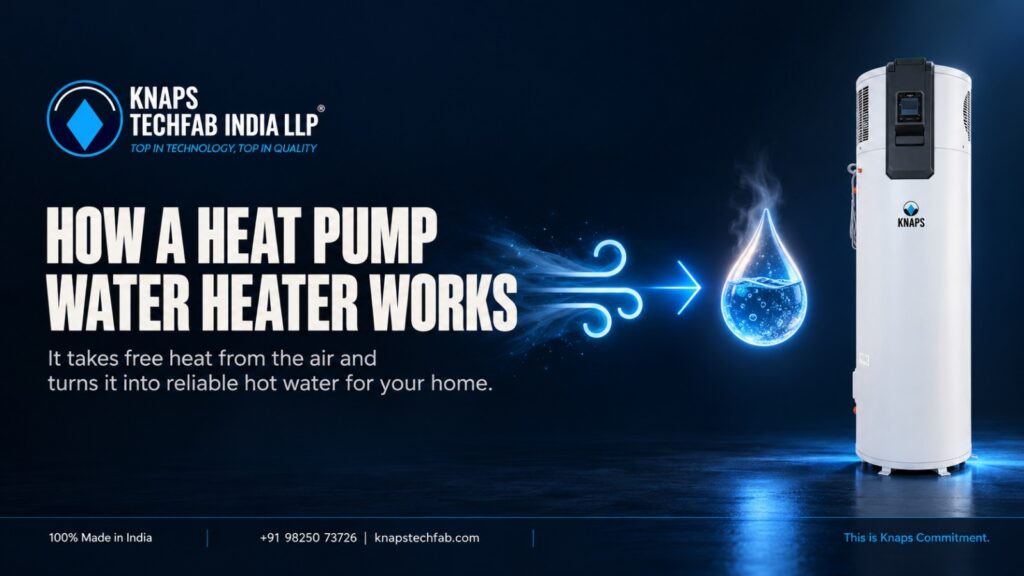
How a Heat Pump Water Heater Works
It takes free heat from the air and turns it into reliable hot water for your home.
The simple idea
A heat pump water heater does not create heat the way a geyser does. It moves heat. There is already warmth in the air around your home — even on a cool day — and a heat pump simply captures that free heat and transfers it into your water tank. That one shift is why it uses a fraction of the electricity.
The 4-step cycle
Inside every KNAPS unit, four steps repeat continuously. 1) Absorb: a fan pulls in ambient air and passes it over an evaporator, where a refrigerant soaks up the heat. 2) Compress: a compressor squeezes that refrigerant, raising its temperature sharply. 3) Transfer: the now-hot refrigerant passes through a condenser wrapped around the water tank, releasing its heat into the water. 4) Reset: the refrigerant expands, cools, and the cycle begins again.
Why it is different from a geyser
A conventional geyser uses an electric element to convert electricity directly into heat — one unit of electricity gives roughly one unit of heat. A heat pump moves 3–4 units of heat for every one unit of electricity it draws, because most of the energy is harvested from the air, not bought from the grid.
Built for every scale
KNAPS air-source heat pump water heaters are engineered for Indian conditions and scale from 300 litres to 10,000 litres — from a single home to hotels, hospitals and industry. Same core technology, sized for your real demand.