
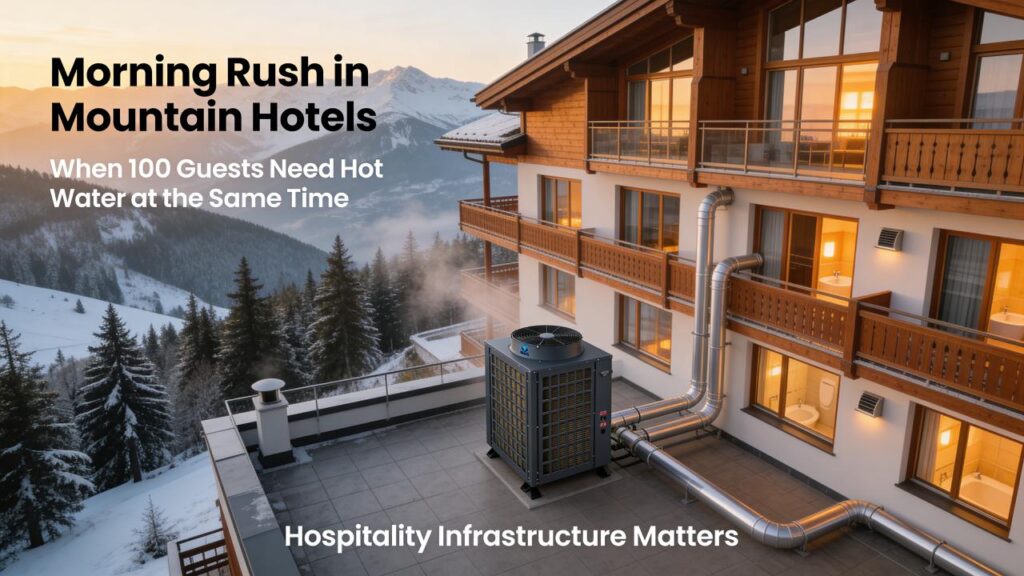
Hill-station hotels don’t get second chances.
Guests arrive for comfort — warm rooms, scenic views, and most importantly, a perfect hot shower. But behind that simple expectation lies one of the biggest operational challenges in hospitality: morning hot water demand.
Between 7 AM and 10 AM, dozens of guests across multiple rooms start their day at the same time. Showers run simultaneously. Demand spikes instantly.
And this is where most systems fail.
Water temperature fluctuates. Pressure drops. Some rooms get lukewarm water. Others get none. What seems like a small issue quickly turns into guest complaints — and in hospitality, even a few bad experiences can impact reviews and long-term reputation.
The problem isn’t demand.
The problem is infrastructure.
Many hotels still rely on individual electric geysers or underpowered systems that simply aren’t designed for peak load conditions. When dozens of units operate together, energy consumption shoots up — but performance still drops.
Modern hospitality is shifting toward centralized systems built for scale.
Heat pump technology changes how hot water is delivered. Instead of generating heat using high electricity input, it transfers heat from the surrounding air — enabling consistent supply even during peak demand.
The result is simple:
• stable water temperature
• reliable performance across rooms
• significantly lower energy consumption
Because in mountain hospitality, comfort is not created in the room.
It’s engineered behind the scenes.