
The Everyday Comfort We Rarely Think About
Hot water is one of the simplest comforts of modern living, yet it plays a crucial role in our everyday routines. From early morning showers to washing dishes in the kitchen, hot water quietly supports countless activities throughout the day.
Because it feels so ordinary, most people never stop to question how that hot water is produced.
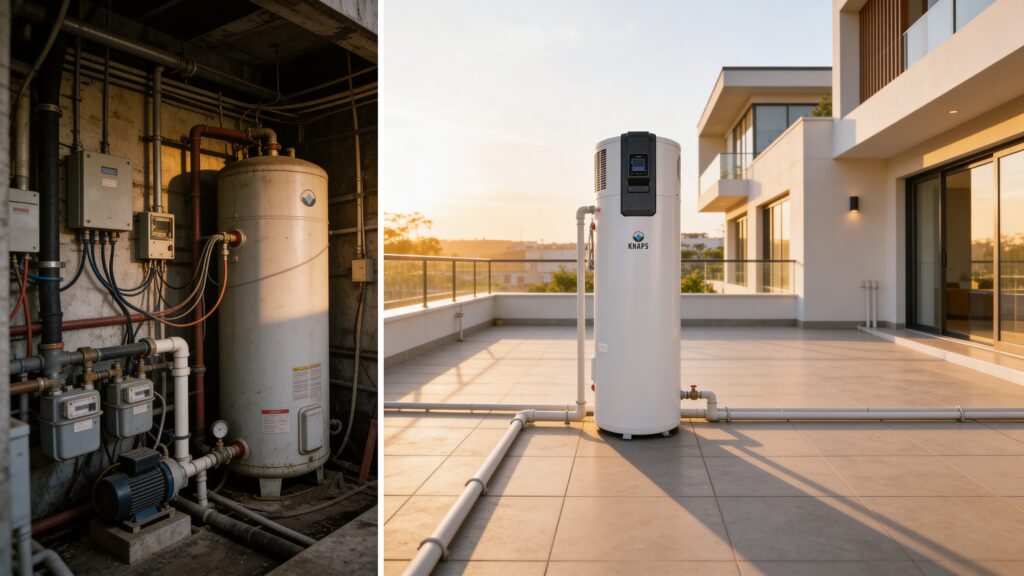
For decades, the most common solution has been traditional electric heaters or geysers. These systems work on a straightforward principle: electricity is converted directly into heat, and that heat warms the water stored inside the tank.
The process is simple, familiar, and widely used.
However, simplicity does not always mean efficiency.
As electricity costs rise and energy awareness grows, many homeowners and property developers are beginning to reconsider how their water heating systems actually work.
The Hidden Energy Cost of Traditional Water Heating
Traditional electric water heaters consume a significant amount of electricity.
Every time hot water is used—whether it’s for a shower, washing clothes, or cleaning utensils—the system must reheat the water. This repeated heating cycle happens multiple times every day in most homes.
In smaller households, the impact may seem manageable.
But in larger homes, villas, hotels, or resorts where hot water demand is much higher, electricity consumption can increase dramatically.
Multiple bathrooms, continuous usage, and larger storage tanks mean the heater must work harder to maintain the required temperature.
Over time, this leads to higher electricity bills and greater energy consumption.
The problem is not the need for hot water.
The problem is the way it is traditionally produced.
A Smarter Approach to Water Heating
Modern technology is changing how water heating systems operate.
Instead of generating heat directly from electricity, advanced heating systems use a more intelligent method: transferring heat from the surrounding air.
This is where heat pump technology comes in.
A heat pump does not create heat in the same way a traditional heater does. Instead, it captures heat from the ambient air and transfers it into the water. Because the system moves heat rather than generating it directly, the electricity required to operate the system is significantly lower.
In practical terms, this means the same amount of hot water can be produced using far less electricity.
For homeowners, the result is lower energy consumption and reduced electricity bills.
For larger properties such as villas, hotels, or resorts, the impact can be even more significant.
Intelligent Systems for Modern Living
As homes and buildings become more advanced, infrastructure systems are also evolving.
Lighting systems are becoming smarter. Air conditioning systems are becoming more energy efficient. Smart home technology is helping people manage energy usage more effectively.
Water heating is now becoming part of this transformation.
Instead of relying on outdated systems that consume large amounts of electricity, modern buildings are beginning to adopt intelligent heating technologies designed for efficiency.
These systems not only provide reliable hot water but also support sustainable living by reducing overall energy demand.
In a world where energy efficiency matters more than ever, smarter infrastructure is becoming a necessity rather than a luxury.
The Future of Water Heating
Hot water will always remain an essential part of everyday comfort.
Homes, hotels, and commercial spaces will continue to rely on reliable heating systems to support daily routines.
What is changing is the technology used to produce that comfort.
The future of water heating is not just about generating heat quickly. It is about producing hot water efficiently, intelligently, and sustainably.
Sometimes innovation is not about doing something completely new.
Sometimes it is about doing the same thing—just in a smarter way.
And when it comes to water heating, intelligence makes all the difference.