
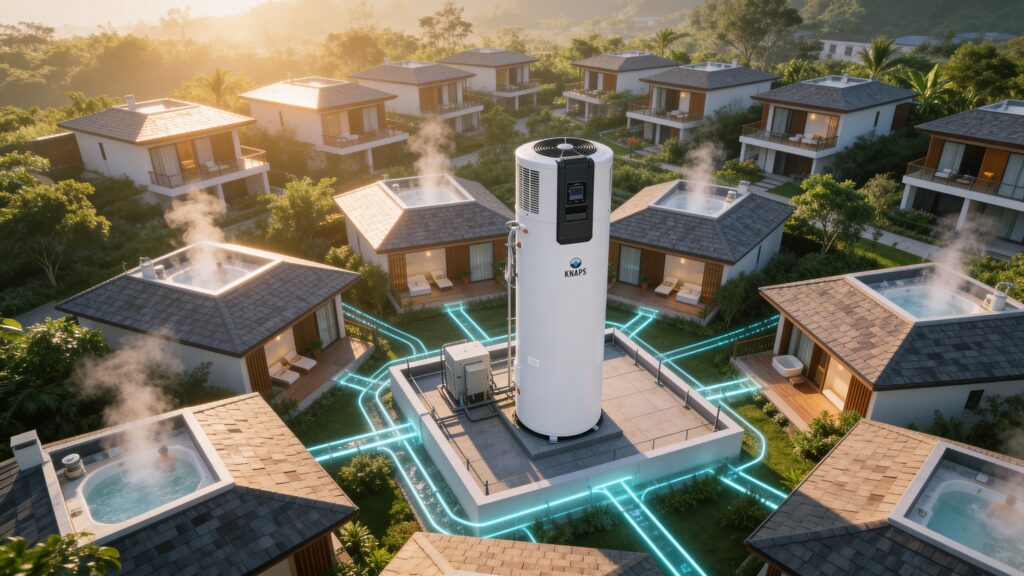
The Unique Demands of Resort Operations
Resorts operate very differently from typical residential properties.
Unlike homes where hot water usage is limited to a few people, resorts must provide hot water for dozens or even hundreds of guests every day. From early morning showers to late-night baths, the demand for hot water remains constant throughout the day.
Guests staying at resorts expect comfort without interruption.
Whether they are relaxing in a villa, using spa facilities, or preparing for an evening event, reliable hot water is a basic expectation.
If hot water supply becomes inconsistent or delayed, the guest experience can quickly be affected.
This makes water heating infrastructure one of the most important systems in hospitality properties.
The Energy Challenge Behind Hospitality Comfort
Providing consistent hot water across an entire resort requires a significant amount of energy.
Multiple guest rooms, villas, kitchens, laundries, and spa facilities all rely on hot water systems operating efficiently.
Traditional water heating systems typically generate heat directly using electricity or fuel. While these systems can provide the required temperature, they often consume large amounts of energy to maintain supply.
As occupancy increases, so does hot water demand.
When many guests use hot water at the same time—especially during peak hours in the morning and evening—traditional heating systems must work harder to maintain temperature.
This increased workload leads to higher electricity consumption and rising operational costs.
For resort owners and operators, managing these energy costs becomes a major challenge.
Why Traditional Systems Are Becoming Less Efficient
Conventional water heating systems were designed for simpler demand patterns.
However, modern hospitality properties often have multiple villas, larger guest capacities, and additional facilities such as spas and heated pools.
These factors significantly increase hot water requirements.
Traditional systems often struggle to handle this continuous demand efficiently.
To compensate, resorts may install larger heating units or operate multiple systems simultaneously. While this ensures hot water supply, it also increases electricity usage and operational expenses.
Over time, the cost of maintaining these systems becomes a substantial part of the resort’s energy bill.
This is why many hospitality businesses are exploring more efficient alternatives.
The Heat Pump Advantage
Heat pump technology offers a smarter and more energy-efficient approach to water heating.
Unlike traditional systems that generate heat directly from electricity, heat pumps capture heat from the surrounding air and transfer it into water.
This process requires significantly less electricity while still delivering consistent hot water supply.
For resorts, this efficiency creates several important advantages.
First, electricity consumption is reduced, which helps lower operational costs.
Second, heat pump systems are designed to handle continuous demand, making them suitable for hospitality environments where hot water is required throughout the day.
Third, these systems support sustainability goals by reducing overall energy consumption.
Building More Efficient Hospitality Infrastructure
Guests may never see the systems responsible for their comfort.
But behind every relaxing shower or spa experience is an infrastructure network that makes it possible.
Modern resorts are increasingly focusing on intelligent infrastructure that delivers both comfort and efficiency.
Energy-efficient technologies like heat pumps allow hospitality businesses to maintain high service standards while managing operational costs more effectively.
As the hospitality industry continues to evolve, infrastructure decisions will play an even greater role in shaping guest experiences.
The resorts of the future will not only offer beautiful locations and luxury amenities.
They will also rely on smarter systems that quietly deliver comfort every day.